
How can vibration be avoided in stainless steel?
Although tool geometry is crucial, vibration in stainless steel often originates from insufficient static rigidity of the setup. To eliminate vibration at its source, minimize tool overhang and use face-contact clamping systems (Dual Contact such as Big-Plus or HSK), which increase radial rigidity. It is equally important to ensure that the workpiece does not “breathe” under cutting load by placing clamps or vises at the rigid support points of the machine table.
Why does chatter occur when milling stainless steel?
Chatter is a regenerative phenomenon. In stainless steel it is easily triggered because:
- Resonance Frequency: The density and elastic modulus of stainless steel, combined with high cutting forces, can excite the machine’s natural frequencies.
- Interrupted Cutting: If the cutter has even minimal run-out, one tooth cuts more than the others, creating a pulsating force that destabilizes the system.
- Internal Damping: Stainless steel has lower vibration damping than cast iron, so once vibration starts, it tends to sustain itself.
Which parameters reduce vibration and chatter in stainless steels?
Anti-vibration parameters for stainless steel can be counter-intuitive:
- Increase Feed (fz): Low feed promotes rubbing and chatter. Increasing fz stabilizes the cut by preloading the spindle.
- Vary Speed (Vc): If the typical “whistling” sound is heard, changing spindle speed by ±10% often breaks the resonance.
- Depth of Cut (ap): Reducing ap should be the last resort. It is better to reduce radial engagement (ae) while keeping ap deep to exploit the axial rigidity of the cutter.
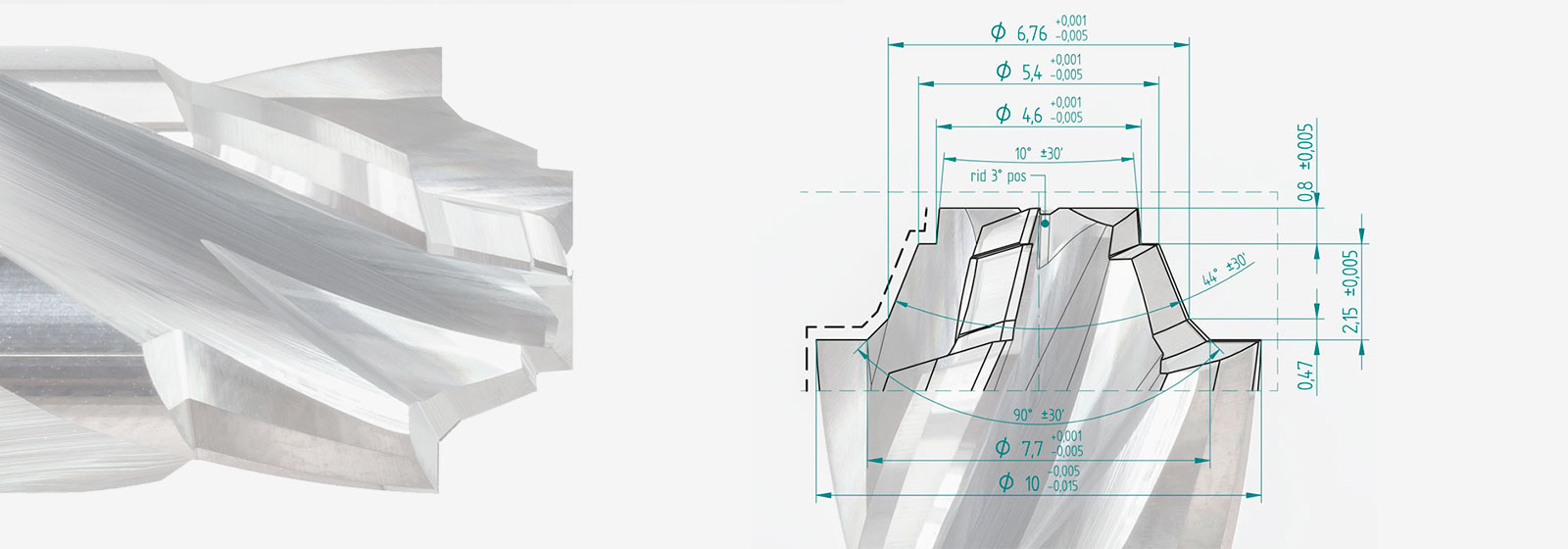
Which end-mill geometry helps reduce vibration in stainless steel?
The ideal anti-vibration geometry for stainless steel includes:
- Variable Pitch: (e.g. tooth angles of 88°-92°-89°-91°) to avoid constant harmonics.
- Variable Helix: (e.g. 35° and 38°) to change the direction of the force vector from moment to moment.
- Corner Radius: A small corner radius (e.g. 0.2-0.5 mm) is more stable than a sharp corner because it reinforces the tip, but it is less prone to vibration than a large radius that increases contact pressure.