
Cobalt Leaching
Cobalt leaching is a serious, internationally recognised problem that can affect cutting tools. It occurs when cobalt separates out within the surface layer of the material. Because cobalt is the binder that holds tungsten carbide together, losing it weakens the bond and adhesion between the carbides (tungsten carbide and mixed carbides) and the PVD coating, causing severe premature wear. This must therefore be avoided at all costs, so as not to ruin the tool. There are several causes behind it. The main ones are chemical and thermal. For this reason, choosing the right coolants during machining is essential to prevent cobalt leaching. The machining parameters — coolant flow rate, grinding pressure, wheel feed rate and so on — must likewise be set to suit both the material being worked and the surface coatings applied afterwards. To get the most out of the PVD coating, the entire production process needs to be analysed in detail.
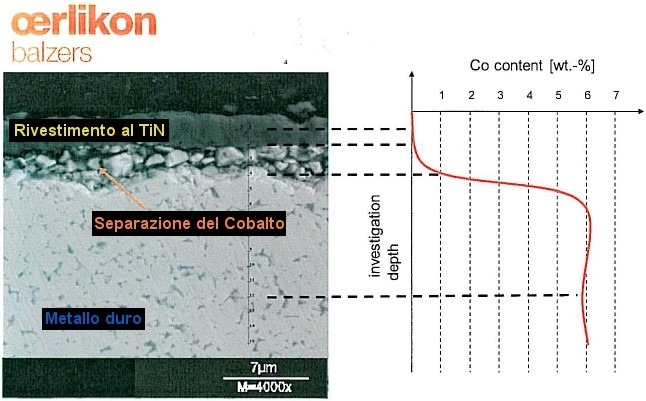
Cross-section of a polished, TiN-coated tungsten carbide showing the “cobalt leaching” phenomenon (left). The EDX line scan (right) shows how the loss of cobalt in the surface layer of the tungsten carbide undermines the bond between the carbide body and the tool’s surface coating. Under these conditions, good coating adhesion simply cannot be achieved.