
How can delamination be avoided in engineering composites?
Machining technical composites (CFRP, GFRP, Kevlar) presents the critical challenge of delamination, i.e. separation of the layers that make up the laminate. To avoid it, the main objective is to control the Axial Thrust Force. When this force exceeds the strength of the resin binding the fibers, separation occurs.
The technical solution is to reverse the forces: instead of “pulling” the fibers outward, they should be “compressed” toward the core of the material. This is achieved mainly through the choice of tool geometry (e.g. compression cutters) and by modulating feed at entry and exit so as not to exceed the load limits of the polymer matrix.
Why do engineering composites delaminate during milling?
The delamination mechanism is twofold and depends on the direction of the cutting force relative to the laminate plane:
- “Peel-Up” Delamination (Entry): Occurs on the top surface. If the cutter has a standard positive helix, the vertical component of the cutting force tends to lift the upper fibers before they are cleanly severed.
- “Push-Out” Delamination (Exit): Occurs on the bottom surface. As the tool exits the material, the remaining thickness becomes too thin to withstand axial thrust, bends, and fails through brittle fracture of the resin.
How can delamination in composites be prevented with coated tools?
The coated tool plays a key role in keeping the cutting edge sharp (“Sharp Edge”). A rounded cutting edge exponentially increases vertical thrust force, one of the main causes of delamination.
- Diamond Coating (CVD/DLC): It is almost mandatory. Carbon fiber is extremely abrasive and rapidly wears carbide. Diamond coating preserves the cutting-edge geometry.
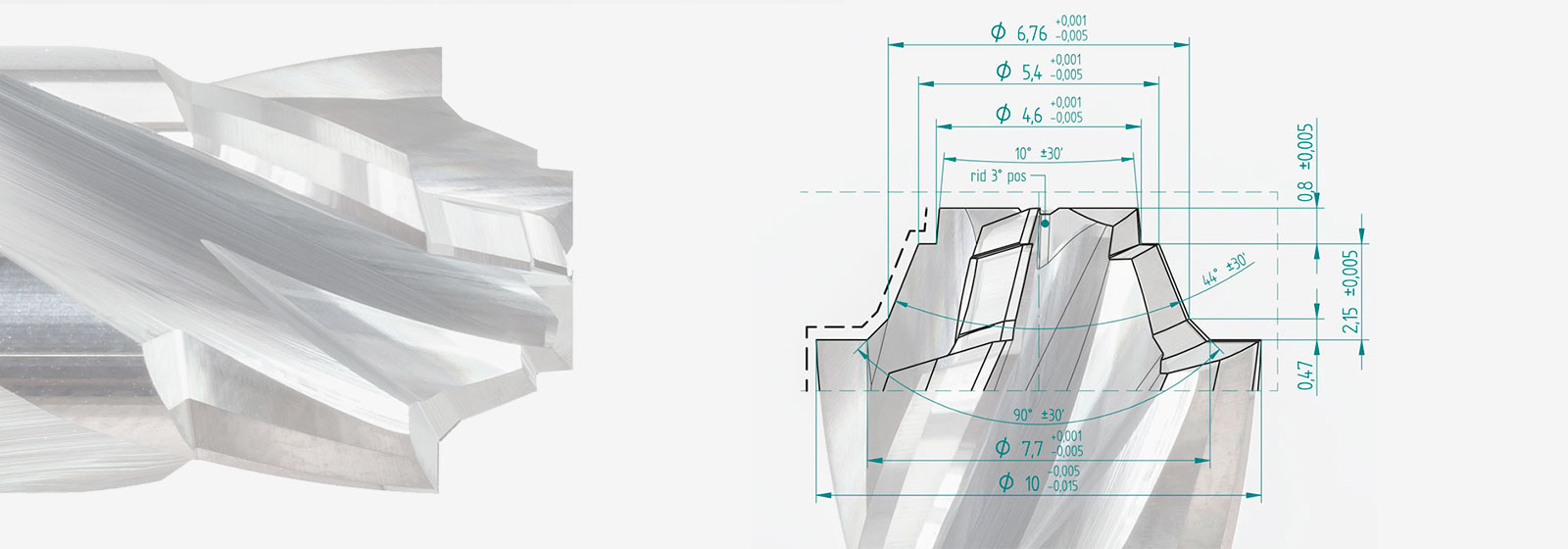
- “Compression” Geometry: Use cutters with a double-helix geometry (right-hand helix at the tip, left-hand helix toward the shank). These tools generate converging forces toward the center of the panel thickness.
Which parameters reduce delamination in composite materials?
To minimize risk, parameters should promote a clean shearing action while reducing pressure:
- High Cutting Speed (Vc): Increasing Vc reduces tangential cutting forces. Care must be taken not to overdo it and melt the matrix if it is thermoplastic.
- Low Feed per Tooth (fz) in Drilling: Especially when exiting the hole, feed should be reduced, even by 50%, to minimize axial thrust.
- Entry Strategies: Avoid pure vertical plunging. Prefer helical ramp entry.