
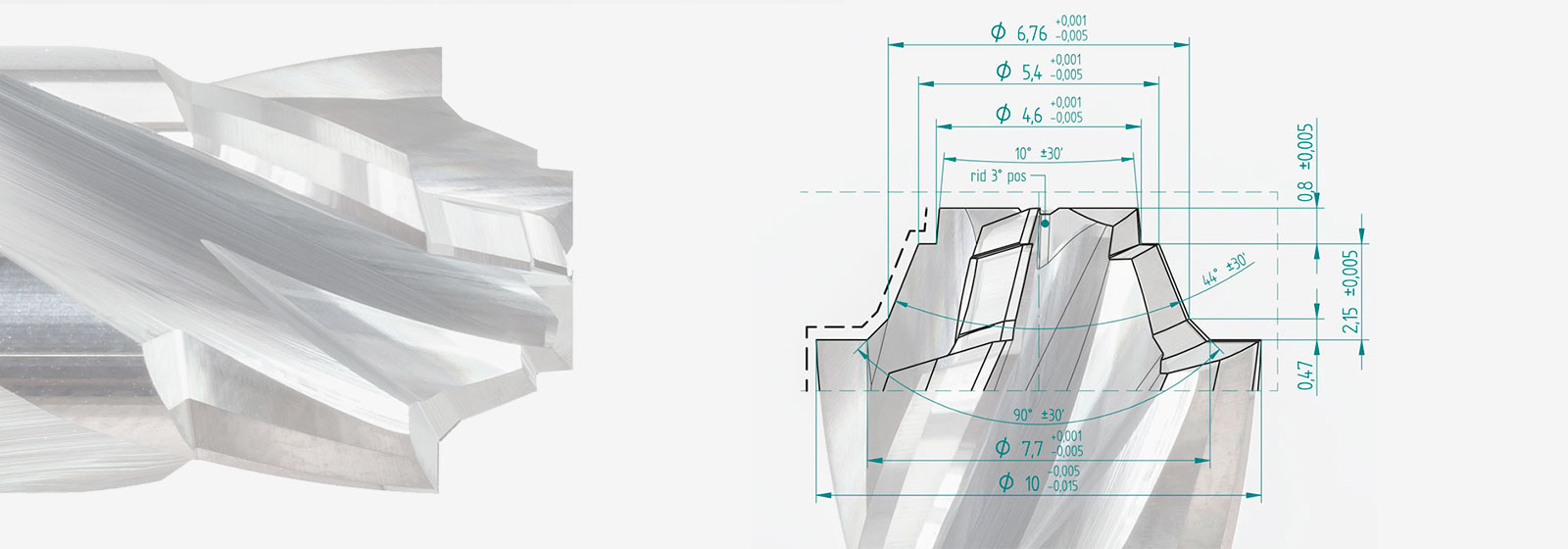
How can a better finish be achieved in titanium?
To improve the finish on titanium, in addition to tool geometry, attention must be given to dynamic stability. High-frequency “invisible” vibration leaves a dull micro-roughness. Vibration-damped holders and flange-to-spindle contact systems (Dual Contact) can significantly improve Ra. A constant-chip-thickness finishing strategy also helps maintain uniform cutting pressure.
Which end mill should be used to achieve a good surface finish on Grade 5 titanium?
Dedicated finishing cutter:
- Never use the same cutter for roughing and finishing. Microscopic wear from roughing degrades the finish.
- Cutters with different helix angles between flutes (e.g. 45°/48°) cancel harmonics.
How can tool marks and vibration be reduced when finishing titanium?
Reducing marks:
- Wall Overlap: In multiple Z passes, leave minimal overlap or use a continuous ramp to avoid junction lines.
- Deflection: A spring pass with zero or almost zero stock may help, but on titanium it can work harden the surface. A single correctly loaded finishing pass is usually better.
Which parameters improve titanium finishing while reducing burrs?
Titanium finishing parameters:
- Vc: 80-120 m/min, higher than for roughing.
- fz: Low (0.03-0.05 mm), but not so low that rubbing occurs.